
Data sharing is key to a sustainable presence on the Moon
How Open Lunar is helping make lunar data more accessible — and why it matters for this era of lunar exploration.
Interest in the Lunar South Pole increases, while datasets remain incomplete
The global rush to the Moon in this century is grander in ambition than Apollo. Compared to Apollo, more countries and companies are planning an increased cadence of robotic and human missions with longer operational periods, working towards eventual lunar bases that will utilize in-situ resources like water ice and oxygen & metals.
The site of most upcoming mission plans is the lunar South Pole—a region still relatively unexplored relative to near-equatorial or mid-latitude sites, which brings new challenges. The lunar poles are characteristically harsh—with steeper slopes, limited Sun and Earth visibility to support power and communications, and extreme thermal environments. Harsh lighting conditions persist on the lunar south pole due to a perpetually near-horizon Sun. The combination of extreme terrain and unfavorable illumination conditions make autonomous robotic spacecraft operations difficult.
Data from the South Pole region is also limited. We currently rely on orbital datasets, which have limited, coarse resolutions for imagery and physical & chemical data compared to ground data from surface missions. Although new orbital missions are being planned, next-generation orbiters are not planning coordinated observations beyond a handful of polar sites, which limits our ability to improve data quality and availability by compounding datasets.
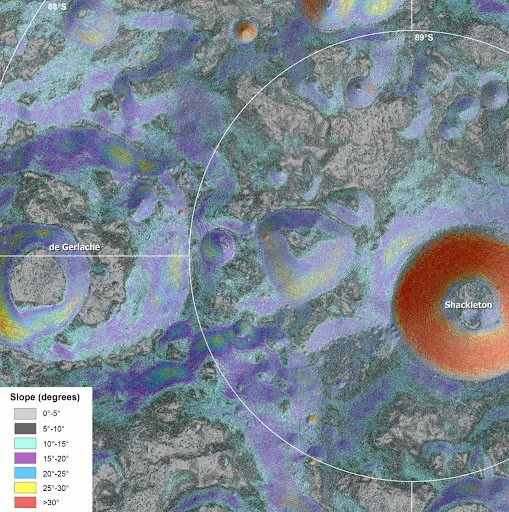
The steep slopes at the Moon’s south pole (85–90°S). Image: CLSE / LPI
Data Sharing is key to improving mission success
Better data could dramatically reduce risk for future missions. Fifty percent of robotic lunar landing attempts have failed. Some programs — like China’s Chang’e — have higher rates of success, perhaps enabled by lessons-learned shared between missions. In the case of commercial programs — like NASA’s Commercial Lunar Payload Services (CLPS) program — which include multiple private competitors, information and data sharing between lunar operators may be difficult. Lessons from failed attempts or successful landings may remain siloed.
On the whole, at a global scale, mission data and information sharing for lunar missions is largely fragmented, incoherent, and incompatible between lunar actors.
Marieta Valdivia Lefort of the Royal Astronomical Society, and Lunar Ledger Advisor, has highlighted the risks inherent to barriers to technical interoperability:
“Lunar missions…depend on accurate ephemeris data, surface coordinates, timing synchronisation, and environmental measurements. These are essential for safe operations, Moon-based astronomy, and studies of polar water ice. And yet space agencies, companies, and universities still use different data formats, reference frames, metadata, and procedures.”
Improving shared data assets can support safer landing and operations, while maintaining a safe lunar operational environment. In addition to addressing technical risks, sharing data about lunar south pole resources can inform mission planning. In the past, datasets from lunar science missions— generally made public — led to increased interest and funding for lunar exploration.
NASA’s Moon Mineralogy Mapper on ISRO’s Chandrayaan 1 mission led to the mineral mapping and discovery of water ice that has catalyzed the recent uptick in lunar missions. Most 21st century Moon missions rely on over 1.6 petabytes of data shared freely by NASA’s Lunar Reconnaissance Orbiter (LRO) mission. LRO’s high-resolution imagery and topographic data has been the bedrock for filtering landing sites in particular. Likewise, scientific data from China’s lunar missions continues to be made available through their Lunar and Planetary Data Release System. Chang’e 5 lunar samples have been shared with international researchers to better understand the Moon’s evolution.
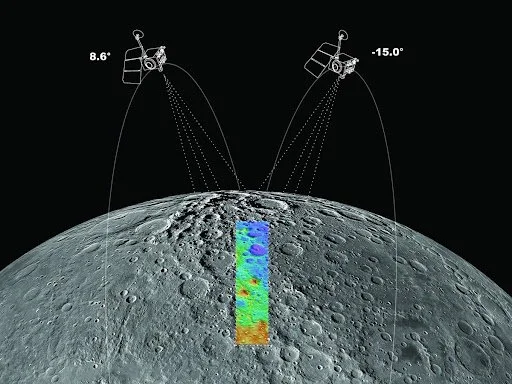
Illustration of NASA’s LRO spacecraft mapping a section of the Moon at different angles over consecutive orbits to create a 3D topographic image. Image: NASA / LROC
Two upcoming missions have plans to study and characterize the Moon’s south pole: India’s Chandrayaan 4 sample return mission, and Chandrayaan 5 / LUPEX, a joint ISRO-JAXA mission to study shadowed polar water ice. ISRO could share findings, and especially lunar samples, with the broader international community, to benefit future crewed polar missions. Chandrayaan 5 / LUPEX — a partnership between India and Japan — will include data sharing between the partners in standard, accessible formats.
The first commercial lunar dataset on the Lunar Ledger
To encourage lunar mission data and information sharing, the Open Lunar Foundation soft-launched the Lunar Ledger project last year. The Ledger is a global, open-access database of lunar missions, payloads, and surface activities. Building on three collaborative years of research, development, and community consultations, the Ledger aims to consolidate data from governments, research institutions, and companies into a shared system that supports mission success, safety, and increased coordination at the Moon. Six companies have signed up for the Ledger, with commitments for mission data sharing: ispace, Firefly, Astrolab, JAOPS, Dymon, and SpaceData.
As the Ledger approaches a full public launch this year, JAOPS and Dymon have agreed to make operational data from their YAOKI lunar rover — which flew onboard Intuitive Machines’ IM-2 lander — open access.
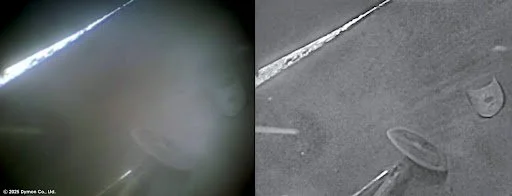
The IM-2 lander’s leg pictured by the YAOKI rover on the Moon. Images: Dymon / Phil Stooke
While YAOKI couldn’t be deployed on the lunar surface, the rover managed to capture images from the spacecraft, capturing a lunar crater rim and a leg of the IM-2 lander. The team shared these images publicly online last year, enabling analysis .
“Opening up the images really spurred both citizen scientists and academics to analyze what happened more than we [the mission team] could’ve done alone,” said Louis Burtz, co-founder of JAOPS.
As part of the public Lunar Ledger launch, the YAOKI team intends to share all the raw telemetry and telecommands from their mission through Yamcs Mission Control Software, a project which is also open source on GitHub. “Through our approach, we hope to encourage future missions and payloads to do the same,” noted Burtz. “Honestly, it also provides credibility for our company and its mission to promote best practices in spacecraft operations.”
Jonathan McDowell, an astronomer, spaceflight tracker, the creator of the popular Jonathan’s Space Reports, and advisor to the Lunar Ledger, said regarding the new YAOKI data release that “the more organizations that do this, the more we’ll all benefit.”
The Ledger is gradually gaining global momentum. Recognizing the importance of free sharing of scientific and related technical data between polar Moon missions, COSPAR, the largest international scientific society dedicated to promoting space research cooperation worldwide, signed a Memorandum of Understanding with the Open Lunar Foundation on March 20, 2026 to support information sharing related to the Ledger and noted the following:
“As lunar exploration accelerates, the collaboration between COSPAR and Open Lunar Foundation ensures that scientific insight informs cooperation, transparency, and responsible knowledge sharing, while fostering dialogue across the global community and supporting more coordinated and sustainable approaches to the governance and conduct of lunar activities.
“This development is an important step in giving Open Lunar Foundation both visibility and legitimacy as a real player,” noted McDowell.