

AUTHOR: RAE SMITH-COHN
Twelve people have walked on the Moon and none of them claimed it. The next arrivals are coming to stay, and whoever gets there first could set the rules for everyone else. Open Lunar’s answer, from the Res Luna project to the Lunar Ledger, is to agree on the rules before the first perimeter is drawn.
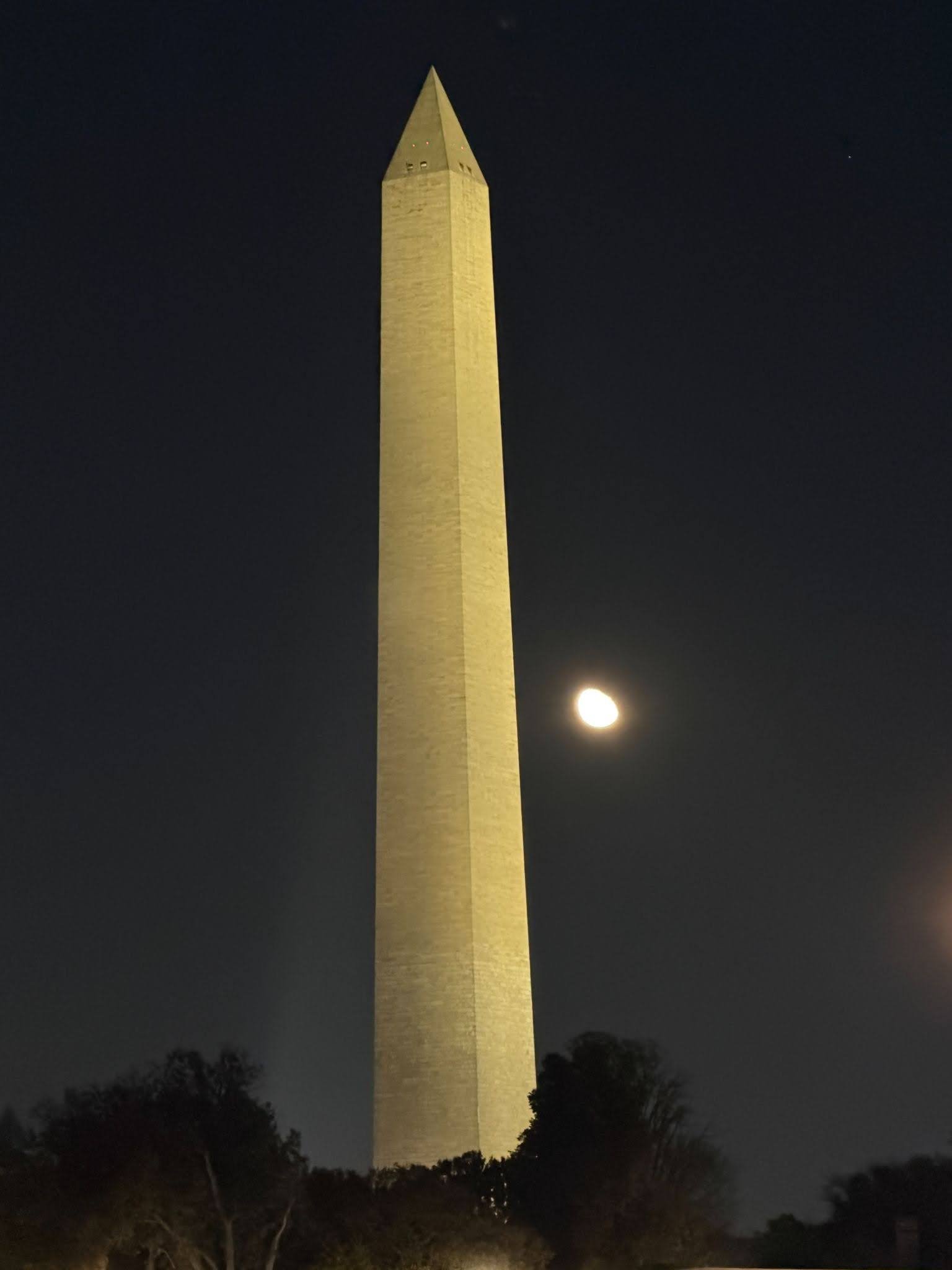
The Hunter’s Moon over Washington, DC, October 2026.
Last week, in Washington, D.C., there was a beautiful display of the Hunter’s Moon that captivated the city. People stopped to point at the sky, take photos with their phones, and gaze at the awe-inspiring sight of a full Moon in the sky. Though, it did not seem to occur to anyone to prompt a discussion about who owns it.
The New York Times recently published a piece on this exact topic and noted that in 1967, the answer as to who owns the Moon was “no one,” but in 2026, the answer is less clear. World superpowers are now rushing to put nuclear reactors on the Moon’s South Pole. This means that whoever arrives first could draw a perimeter around their reactor, forcing others to stay outside their location. Therefore, precedent-setting by those who arrive first is inevitable, unless the rules are agreed before they arrive.
“This era hinges on the belief that first is best and that whoever sets up on the moon quickest can set the rules.”
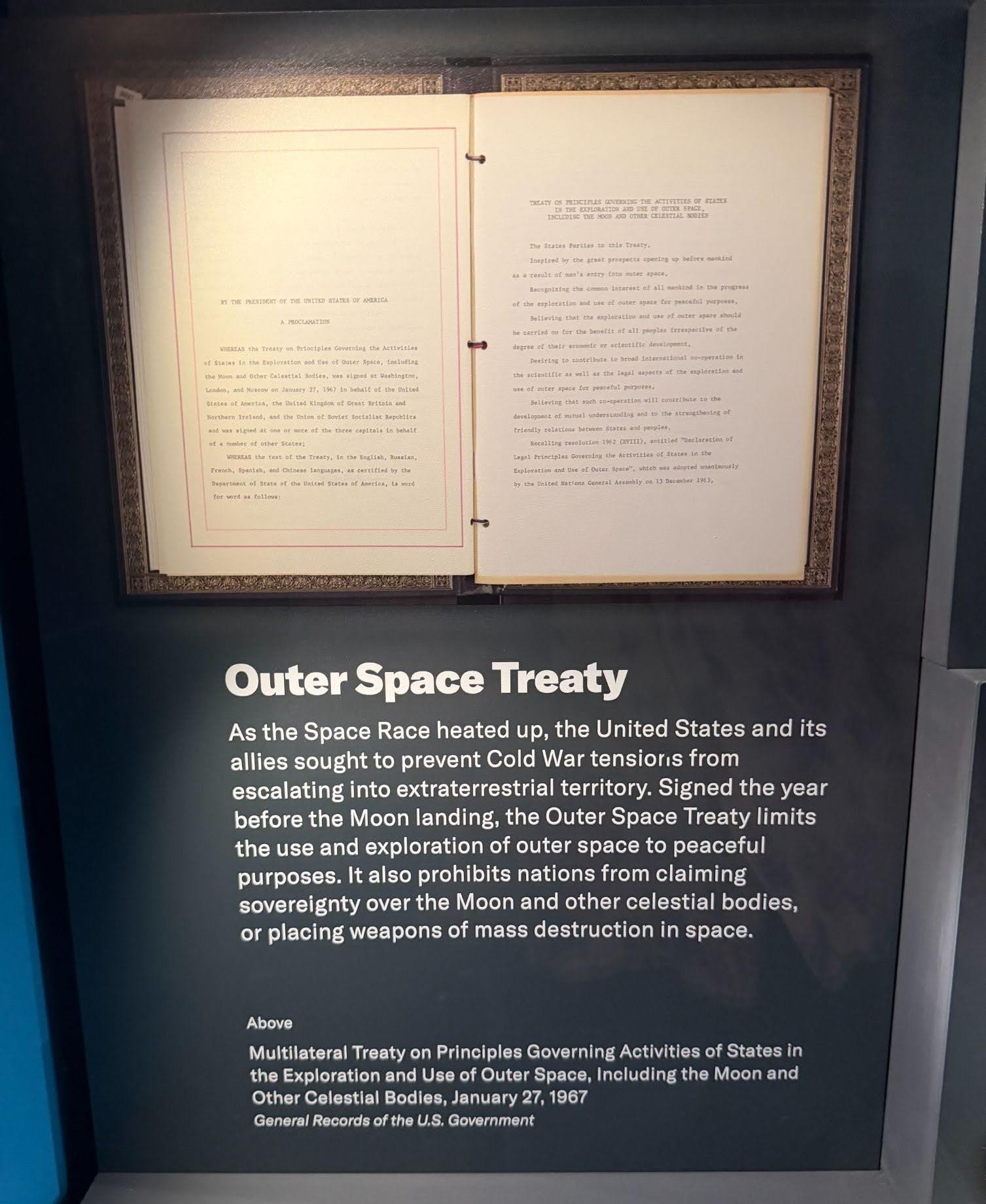
National Archives in Washington, D.C., October 2026
A visit to the Outer Space Treaty at the U.S. National Archives prompted a reminder of a key line from Article II: “Outer space, including the Moon and other celestial bodies, is not subject to national appropriation by claim of sovereignty, by means of use or occupation, or by any other means.” The United States and the Soviet Union signed the Outer Space Treaty in January 1967, two and a half years before anyone had set foot on the Moon. Even while racing one another to arrive first, they agreed that no nation could claim the Moon.
So if the Moon isn’t owned by anyone, but at the same time it’s for the benefit of all, how is that managed?
Elinor Ostrom, who won the Nobel Prize in economics in 2009, studied real shared resources: mountain pastures in Switzerland, village forests in Japan, and irrigation canals in Spain. She described how communities managed shared resources for centuries without privatizing them or having states take over management, instead agreeing to rules such as boundaries, decision-making, monitoring, and dispute resolution.
Ostrom’s ideas have been part of Open Lunar’s approach from our origins. As Co-Founder and Board Member Jessy Kate Schingler put it in her 2020 TED talk, the treaty’s bans on national appropriation and private ownership “create the conditions for what are called the commons, based on the work of Nobel Prize-winning economist Elinor Ostrom.” Our 2020 working group on lunar resource management was built on her principles. Open Lunar’s Res Luna project applied Ostrom’s frameworks to lunar resources. Breaking Ground Trust, a lunar resources trust that grew out of Open Lunar’s work, is an attempt to build the exact type of institution that Ostrom described: stewarding something on behalf of everyone.
Open Lunar’s current work puts Ostrom’s principle of monitoring into practice. The Lunar Ledger, launched in 2025 with Firefly, ispace, Astrolab, and JAOPS, is a shared registry of lunar activity, so everyone can see where a perimeter is drawn and why. As The New York Times described, those leading the space race are doing so with only a partial view of one another’s plans, and that uncertainty shapes decisions. A shared public record of who is operating, where, and how, will reduce uncertainty and create opportunities to achieve more by working together.
As of today, twelve people have stood on the Moon, and yet none of them have claimed to own it. It’s been over half a century since then, and as The New York Times article infers, the next people who go back, this time to stay, will do so under very different circumstances. This is why Open Lunar builds projects that set precedents: information sharing, holding resources in trusts, and setting standards. Over 50 years ago, we agreed that the Moon belongs to no one. In the next 50 years, we will decide together what that actually means.
Join us in shaping the next 50 years!
Open Lunar works towards a peaceful, enduring presence on the Moon that benefits all life. That means agreeing the rules before the first arrivals set them for us, and it means doing it in the open, with everyone who shares the Moon. If that is a future you want, support Open Lunar’s work with a year-end donation.
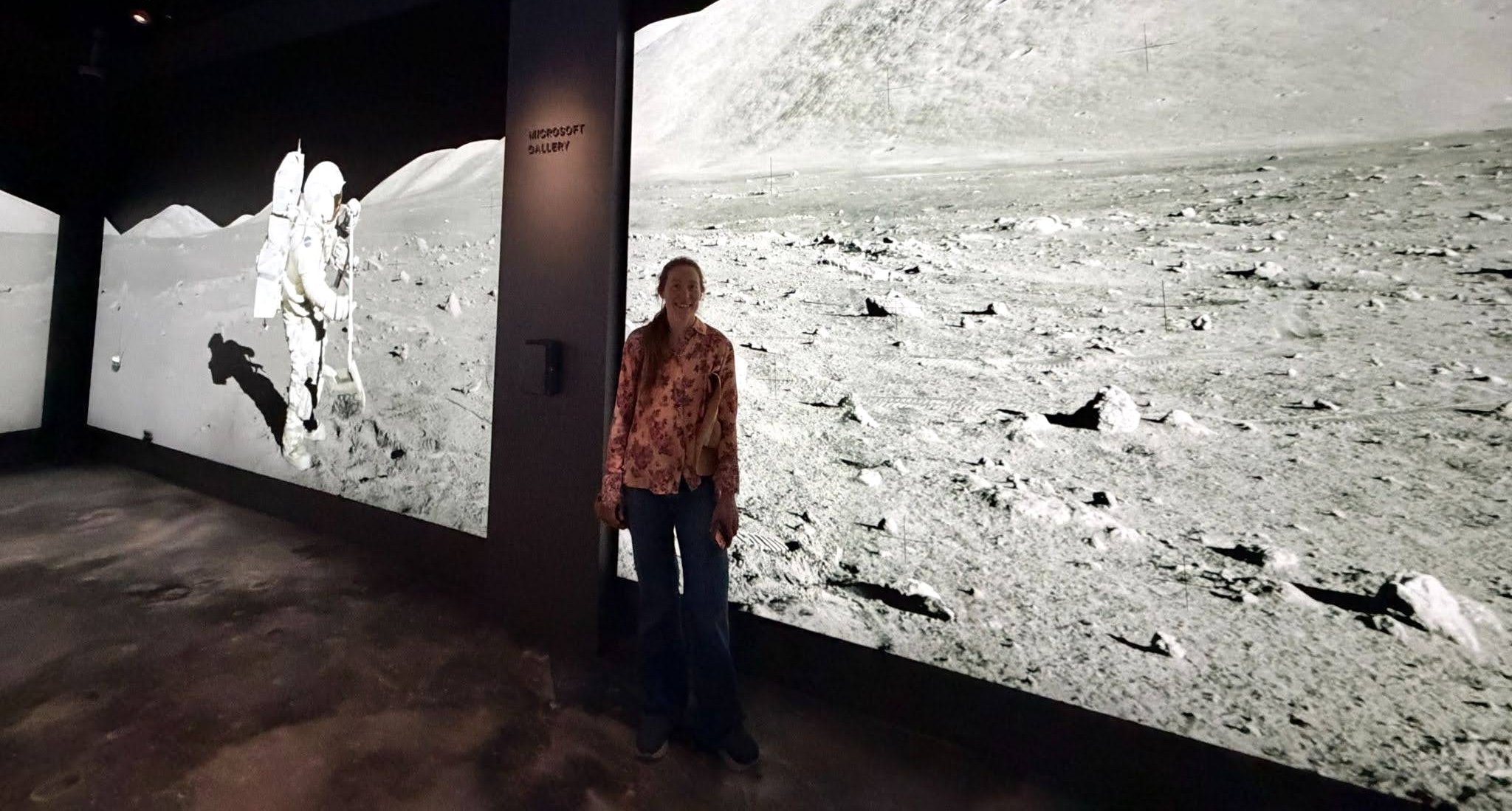
Standing on the Moon, almost. National Archives, Washington, DC, October 2026.
