AUTHOR: AARON MACKEY
The Moon is filling up — and without a way to distinguish legitimate operations from territorial land grabs, the first actors to arrive could lock everyone else out forever. This piece makes the case for Designated Lunar Areas: not as claims, but as coordination infrastructure, drawing on surprising parallels from FCC radio-silent zones to Antarctic governance. The stakes couldn't be higher, and the window to get this right is closing fast.
Introduction
Imagine you're a lunar mission planner. You've surveyed a site at Shackleton Crater for mineral extraction and habitation operations. You've designed your operations carefully and drawn a boundary around the area where your crew will work without impacting the nearby sensitive instruments of the Lunar Infrared Telescope. You announce publicly that the first samples gathered are promising. You even publicly announce your area of operations, all 100 kilometers of it, to establish that you are adhering to the expected norm of notification. Hoping for a bump on the stock market and some breathless articles in the coming days, instead, within hours, you and your company are accused of being lunar robber barons - appropriators. Competing operators claim your safety zone is a land grab, and space agencies say it precludes open access.
This is the tension. Are you allocating operational space for legitimate reasons, or are you using safety zones as a guise for territorial claims? As multiple actors plan for lunar operations, this question will determine whether we can build cooperative, coordinated infrastructure or be subject to competitive fiefdoms. The difference matters for safety, sustainability, and whether the Moon remains a commons or a contested zone.
This is why Designated Lunar Areas (DLAs) are valuable. They are not land claims; they are coordination infrastructure. A collection of practical tools for managing overlapping activities in a place with no governing body, no law enforcement, and no room for mistakes. Understanding this distinction changes how we should approach our activities on the Moon.
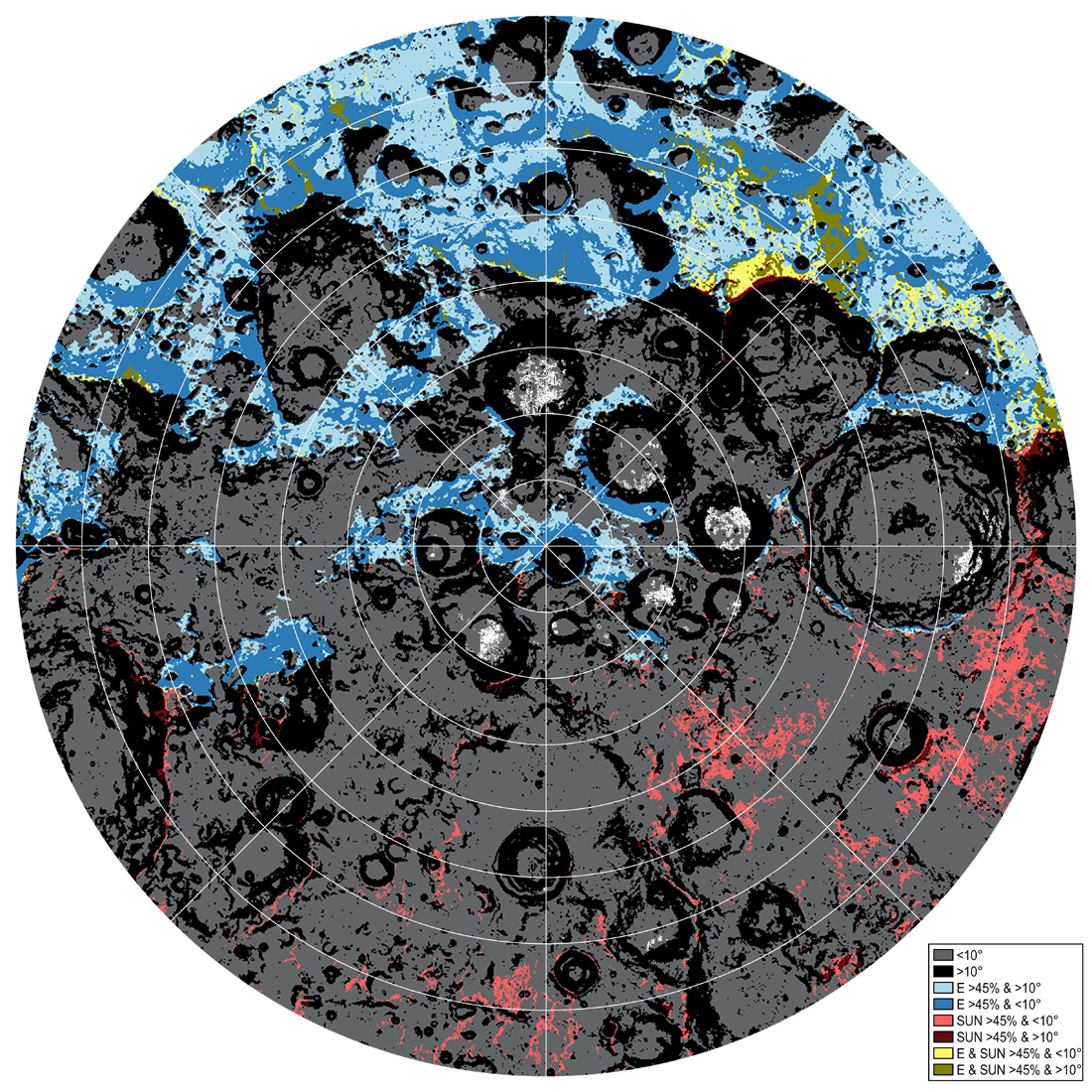
Traversability conditions and landing site assessment on LROC (Credit: LROC)
The Problem: First-Mover Advantage and Lunar Land Rush
The Outer Space Treaty (OST) explicitly forbids the national appropriation of the Moon. According to the treaty, signed and ratified by over 110 nations, "the Moon…shall not be subject to national appropriation by claim of sovereignty, by means of use or occupation or by any other means" (United Nations, 1967, Article 2). As lunar activity has accelerated in recent years, many worry that safety zones, where operators claim exclusive operational control, might violate this principle. When there were only a handful of Apollo sites and some other landers, this principle was never truly tested. Apollo operations were time-bound and constrained by Cold War geopolitics. A mission lasted days or a couple of weeks, and no operator expected to maintain indefinite control. No one was establishing permanent infrastructure for profit, so the principle of non-appropriation worked because no one sought to appropriate anything. The Moon was a destination, not a development zone.
But today's era of exploration is fundamentally different. Companies and nations now plan much longer operation timelines requiring building habitats, extraction infrastructure, power systems, and communication networks. They're not just visiting; they're staying. The recent pivot by companies like SpaceX toward sustained lunar operations, alongside "Space Race 2.0" between the Artemis Accords signatories and other spacefaring nations, represents a fundamental shift from the Apollo era and intensifies the urgency to define the distinction between legitimate operational use of an area and territorial appropriation.
This is where first-mover advantage becomes critical. The first operator to arrive at the crater can claim the best water-ice deposits or claim the radio-quiet zone. After five years or fifty years, their "temporary" operational zone has become their permanent territory, and later operators find the best sites already claimed. This creates a kind of lunar land rush: the first on the scene claim resources indefinitely, while all others are locked out.
Without a framework to distinguish between legitimate operational control and territorial appropriation, this outcome is a real threat. This is why developing a coordination infrastructure is essential. Not to prevent operators from accessing the Moon, but to establish clear, legitimate, equitable mechanisms for distinguishing activity regulation from territorial appropriation.
Regulation Without Ownership: A Solution From Earth
The key to understanding Designated Lunar Areas is a simple conceptual distinction: we must uncouple the regulation of activity in an area from ownership of that area. This distinction is not new. It's embedded in legal systems across Earth, and it's already recognized in international space law.
Consider how nations distinguish between these concepts domestically. For example, the Federal Communications Commission (FCC) regulates radio frequencies without owning the electromagnetic spectrum (47 U.S.C. § 301, 1927). The FCC sets rules about who can broadcast what, where, and when, but the public owns the spectrum, not the FCC. The regulation even extends to land areas in the form of radio-silent zones. The FCC designates areas where radio communications are restricted, typically near sensitive telescopes or military installations (Federal Communications Commission, 1958). Within these zones, you can't broadcast on certain frequencies. Cell phones and radios must operate under different protocols. But critically, you are still permitted in these zones. The FCC could exclude people entirely, but instead allows people to operate there under specific rules. The FCC regulates the activity, not the territory, through the operations themselves and not the land.
Internationally, this distinction appears in the Law of the Sea. The United Nations Convention on the Law of the Sea (UNCLOS) establishes exclusive economic zones (EEZs) where coastal nations have the right to exploit resources and regulate economic activity, but they do not own the ocean itself (United Nations, 1982, Article 56). The ocean remains the province of all humanity as a commons, but activity within designated zones is regulated. Nations agree on fishing quotas, shipping lanes, and environmental standards, but no nation can claim sovereignty over the ocean or prevent other nations from transiting through international waters (United Nations, 1982, Articles 87-89).
This distinction between regulation and ownership is the foundation for Designated Lunar Areas (DLA). DLAs coordinate and regulate activity in an area, such as what operators do, where they do it, and for how long, without claiming ownership of lunar territory.
DLAs in Practice
So what would this look like operationally if a DLA designates a core operations area? It could be a few hundred meters or a few kilometers, depending on the operator's primary mission. Regardless, the first step is transparency. The operator uploads their Designated Lunar Area to an open-source information sharing platform of ongoing activities, such as the Lunar Ledger. Within their DLA, they designate three zones as detailed in the Lunar Operations Field Guide. First, a core area of operations (centered on ice-rich terrain, for example), next a buffer zone accounting for activity-specific hazards like dust dispersal or thermal plumes, and last an outermost area of coordination, along with designated rover paths to and from the site that avoid conflicts with adjacent operations (Open Lunar Foundation, 2025).
Critically, these DLAs are timestamped with expected periods of activity. The operator checks the open-source ledger for any conflicting DLAs already registered. There is ongoing ice extraction at that site, but the mining areas don't overlap; only the buffer zones for dust do. This is manageable. However, the operator sees that the rover path passes through the 1 km buffer zone around a nuclear power site for habitation. A few edits to the rover path and updated timestamps later, the operator submits their DLA and uses it as the reference framework for all operations.
Within that DLA, the operator has control: they manage access, operations, and equipment. But the key distinction is that control is operational, not territorial. They do not own the lunar regolith, and they are not preventing other activities in that area.
Without Designated Lunar Areas, imagine the chaos. Consider another mining operator in the same area. They intend to mine the same ice deposits, but critically, they are not participating in the Lunar Ledger or sharing DLAs with other actors. The two operators both arrive to extract ice, but the newcomer, not using DLA protocols, positions their core operations in the dust buffer of the first operator. Soon, the dust plume begins to degrade the mining equipment of both operators, reducing critical water extraction and possibly endangering crews.
Designated Lunar Areas prevent this chaos. They establish spatial and temporal buffers that enable our two operators to coordinate safely, sharing space without appropriating it. This is a coordination infrastructure, the same principle that guides radio-silent zones by the FCC or maritime traffic under the Law of the Sea, or any terrestrial domain where multiple actors must operate together without ownership.

Print resolution still of our simulated approach to the lunar surface (Credit: NASA)
Grounding DLAs in Current Law
For such a coordination infrastructure to work, it must be grounded in a legally sound foundation. The natural starting place, as previously stated, is the Outer Space Treaty (OST) of 1967.
The treaty explicitly states: the Moon "shall not be subject to national appropriation by claim of sovereignty, by means of use or occupation or by any other means" (United Nations, 1967, Article 2). Under this framework, reserving an area exclusively for one actor, even under the guise of safety, constitutes appropriation if it prevents others from accessing that area indefinitely. Designated Lunar Areas, by contrast, do not create such de facto sovereignty. They only claim operational control of a specific activity in a specific zone and for a specific time. DLAs substitute sovereignty claims for operational coordination and fit squarely within the bounds of existing OST language.
This distinction is not new. The Antarctic Treaty uses similar logic (United Nations, 1961, Article 4). Antarctica is designated as a scientific preserve. Nations can operate there for research, but cannot claim territory. They regulate their own activities without asserting control of the continent. Decades of successful multilateral work in Antarctica demonstrate that these principles work and could guide DLAs on the Moon.
Learning From Low Earth Orbit: Why We Can't Delay
So are Designated Lunar Areas another form of staking a claim on the next land rush? The answer is no. Designated Lunar Areas establish a framework that enables multiple operators to conduct sustained lunar operations (mining, habitation, power generation, research) without any single operator claiming territorial appropriation. They create the operational and governance infrastructure necessary for a shared lunar commons where activity is regulated, but territory remains the province of all humanity. And we don't need to look far to understand the cost of inaction here; the answer lies in Low Earth Orbit (LEO).
When we began launching satellites in the 1950s, there was no coordination infrastructure. Operators launched what they wanted, where they wanted, without worrying about the consequences. For decades, this seemed fine. The orbit was big and debris was negligible. Collision risks were mostly theoretical. Then came the cascade of new constellations as cost to launch reduced. As of 2024, there are over 14,000 satellites in orbit, with more than 10,400 actively functioning, and of these active satellites, over 93% are in LEO (ABI Research, 2024). By the time the space community realized the problem, remediation was expensive and difficult, and preventing future collisions requires elaborate tracking systems and constant maneuvering. The coordination infrastructure came too late, and now we're managing a crisis instead of preventing one.
Building the Framework: What Comes Next
This is where Designated Lunar Areas become essential. Before long-term operators arrive and before the first permanent habitats are built, before mining operations scale up and power grids interconnect, we need to establish the coordination infrastructure that LEO lacked.
We need frameworks that answer:
What disclosure is required before operations begin?
When must operators coordinate with neighbors?
What happens if activities conflict?
How do we distinguish legitimate operational control from territorial appropriation?
Designated Lunar Areas, grounded in the Outer Space Treaty and modeled on successful terrestrial and maritime governance, offer a path forward. They establish clear expectations for operators. They make transparency and coordination the norm, not the exception. They enable a lunar economy where multiple players can coexist and succeed, but only if they opt in to coordination.
This post has established the conceptual foundation that DLAs are not land claims. They are a coordination infrastructure, and the urgent work is operationalizing this concept because the Moon's future depends on which path we choose now.
In the next post, we'll explore what effective coordination infrastructure looks like in practice, how DLAs translate from principle to operational reality, and we'll begin to answer the deeper questions: Can we build a lunar economy that works for all actors? Or will we replicate the patterns of exclusion and conflict we've created on Earth?
References
ABI Research. (2024). Over 480 orbital launches and 43,000 active satellites expected by 2032. Retrieved fromhttps://www.abiresearch.com/press/over-480-orbital-launches-and-43000-active-satellites-expected-by-2032
Federal Communications Commission. (1958). Docket No. 11745: National Radio Quiet Zone. Retrieved fromhttps://www.ecfr.gov/current/title-47/chapter-I/subchapter-A/part-1/subpart-F/subject-group-ECFR8fff3365c42ee11/section-1.924
Open Lunar Foundation. (2025). Lunar Operations Field Guide: Lunar Designated Areas (C. Tiballi, Author). Retrieved fromhttps://www.openlunar.org/publications/lunar-areas-field-guide
United Nations. (1961). Antarctic Treaty. Retrieved fromhttps://www.ats.aq/
United Nations. (1967). Treaty on Principles Governing the Activities of States in the Exploration and Use of Outer Space, Including the Moon and Other Celestial Bodies. Retrieved fromhttps://www.unoosa.org/oosa/en/ourwork/spacelaw/treaties/outerspacetreaty.html
United Nations. (1982). United Nations Convention on the Law of the Sea. Retrieved fromhttps://www.un.org/depts/los/convention_agreements/texts/unclos/unclos_e.pdf
U.S.C. § 301 et seq. (1927). Federal radio communications act. Retrieved from https://www.law.cornell.edu/uscode/text/47/301
Aaron Mackey is a 2026 Open Lunar Fellow working on geospatial data applications professional leveraging remote sensing solutions to advance open-access frameworks for designated lunar areas and peaceful lunar development.