Artemis II and a Return to the Moon We Share
AUTHOR: RACHEL WILLIAMS
Artemis II marks more than a technical achievement. It is a reminder that humanity’s return to the Moon should reflect our highest aspirations, including collaboration, transparency, and a shared commitment to the future we build there.
“The Moon is the first milestone on the road to the stars.” — Arthur C. Clarke
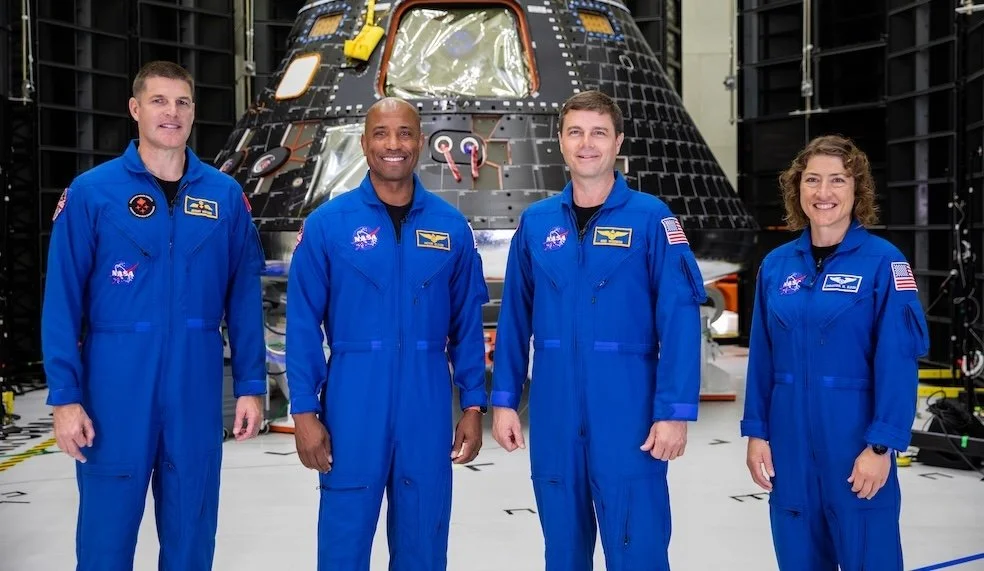
Photo credit: NASA
Artemis II and a Return to the Moon We Share
On April 1, like many of you, our team gathered to watch the historic launch of Artemis II, discussing the significance of the moment and everything that had to go right to get here, along with the long list of things that, along the way, did not. The rollouts, rollbacks, hydrogen leaks, and pushed timelines are the reality of novel engineering in new domains. Artemis II certainly does not represent perfection, but persistence and devotion.
The launch marks a major milestone toward a renewed global commitment to a sustained human presence on the Moon, a future Open Lunar has been working toward since before our inception. The Artemis program, along with other programs led by India, China, Japan, and others, has advanced robotic exploration, surface science, and technology development over the past decades.
Artemis II has sent four astronauts on a roughly 10-day journey around the Moon, the first time humans have traveled beyond low-Earth orbit since Apollo 17 in December 1972. The crew of Integrity — Reid Wiseman, Victor Glover, Christina Koch, and Jeremy Hansen — will become the 25th through 28th humans to travel beyond LEO. Victor will be the first person of color to make the journey, Christina the first woman, and Jeremy the first non-American. It is a reminder that lunar exploration can and should reflect values Open Lunar cares deeply about: collaboration, transparency, science, and a broader sense of who gets to be part of humanity’s return.
The mission will generate knowledge about what it takes to keep humans alive and functioning beyond Earth, testing and collecting important information on radiation, navigation, communications delay, life support, and human performance. The knowledge generated should not stay siloed inside one program, but should contribute to a broader pool of shared science and data that strengthens lunar efforts globally.
The mission also very clearly shows that this is already bigger than any one country. Canada is flying Jeremy Hansen. Europe helped build Orion’s service module. Japan is helping develop the pressurized rover hardware intended for later Artemis surface missions. And Artemis II will carry four CubeSats from international Artemis Accords partners, including Germany, Argentina, South Korea, and Saudi Arabia. That matters. The future of the Moon will not and cannot be built by one nation alone. It will depend on whether we treat science, data, and coordination as shared infrastructure.
As the four astronauts leave an Earth that can fairly be described as experiencing a polycrisis — geopolitical fracture, natural disasters, wars and proxy wars, and institutional strain — it is impossible not to see space as having the potential to represent the best of what humanity can be: an off-world domain that is only possible when we bring the best of what we have to offer.
Artemis II reminds us that returning to the Moon is not only about capability. It is about the norms, partnerships, and shared commitments we carry with us.
Our responsibility now is to ensure that our presence there reflects our highest aspirations.
To Victor, Christina, Jeremy, Reid and the entire Earth-side crew: best wishes and safe travels, ad luna from the Open Lunar team.
Rachel Williams is the Executive Director of the Open Lunar Foundation, a US-based non-profit forging and promoting technical and policy building blocks for cooperative and peaceful lunar exploration globally.