Falling Falcons: Coordination, Contamination, and the Case for a Public Record

AUTHOR: SAMUEL JARDINE
Tomorrow’s Falcon 9 impact exposes a wider gap in lunar governance—objects beyond Earth orbit are not systematically tracked, nor is there a reliable record of what operators leave behind. As hundreds of missions converge on a handful of sensitive lunar sites, such information will be essential both to prevent interference and to preserve scientific value.
At 06:35 UTC tomorrow, a spent Falcon 9 upper stage is expected to strike the Moon near Einstein crater at roughly 8,700 km/h, releasing energy equivalent to around three tons of TNT. Its mass, trajectory and impact site have been known for months, worked out not by a space agency but by Bill Gray, an astronomer who has tracked high-altitude debris as a private effort for two decades. The impact epitomises and exposes a wider gap in lunar governance. This being that, but for the efforts of “a few fans in their spare time”, as astronomer Jonathan McDowell noted, objects and debris beyond Earth orbit are not systematically tracked, nor is there a reliable shared record of what operators leave behind on the Moon. As hundreds of missions converge on a handful of sensitive lunar sites, such information will be essential both to coordinate, prevent interference, and to preserve scientific value.
The Limits of Official Tracking
No agency is tasked with following objects of this kind once they leave Earth orbit. When a comparable object was found on a lunar collision course in 2022, US Space Command told CBS News that "we focus on objects closer to the Earth". JPL tracks a lot, but not all, operating spacecraft, and “doesn’t track space junk”. Into this gap, dedicated astronomers volunteer their time and keep their own personal records, often published publicly. Such arrangements work while lunar traffic remains sparse. But ESA now counts over 400 planned lunar missions by agencies and private companies over the next two decades, most drawn toward the same polar areas which combine permanently shadowed craters holding accessible volatiles with nearby high ground both well lit and level enough to land on. Near and medium-term activity is expected to concentrate across fewer than ten sites, in an area roughly 35 km wide by 70 km long. This scale and level of activity will require new systems for not just coordination, but also monitoring the debris, disposal, impact, and potential contamination coming from all this activity.
Contamination as a Shared Problem
Crowding at that density turns an environmental and contamination impact from individual missions into one shared by the global community, because nothing deposited on an airless body stays where it lands. Descent plumes eject material at up to 2 km/s, approaching lunar escape velocity, and debris can travel around the entire body of the Moon. Apollo 12 set down roughly 155 metres from the Surveyor III probe in 1969 and scoured it with plume-driven particles. On current modelling, an installation 5 km from a ten-tonne lander still carries a 37 per cent chance of being struck.
Plot that footprint onto the south pole, and a single Apollo-era lander reaches across most of the candidate Artemis and ILRS sites.
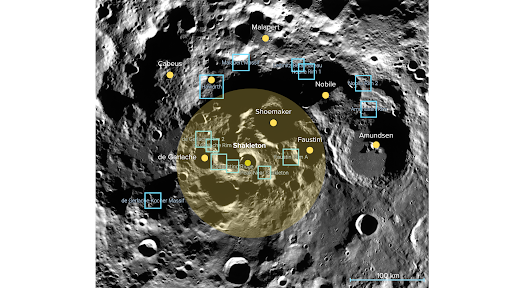
Figure 1. Illustrative plume effects based on Apollo 12. This map places an Apollo-era lander, which is much smaller than many future landers and highlights how this would impact most current candidate sites of Artemis and ILRS, by Open Lunar Foundation, Mehak Sarang (2026), using JPL MoonTrek and Hu et al. (2023).
Chemical contamination disperses further again, with methane exhaust from one landing reaching the opposite lunar pole within two lunar days.
Stakeholder consultations run last year by the Lunar Policy Platform, funded by Open Lunar, published in the Guide to Lunar Science and Ethics, placed, according to scientific stakeholders, dust plumes, exhaust and seismic excitation among the most acute risks to lunar science from human activity, capable of doing irreversible damage to regolith and volatile deposits. Permanently shadowed regions ranked as the most sensitive, since the volatiles that make them worth visiting are the same ones contamination would spoil.
The Record as a Scientific Instrument
Some contamination is unavoidable, and some has already occurred, so restraint alone will not resolve this. Stakeholders have noted that the survival of scientific value could depend on whether anyone knows what was deposited, where, and by whom. Contamination that can be identified and subtracted need not compromise a sample, so declaring it in advance allows experiments to be designed around it. A public record of disposals and their material composition therefore directly serves science, and is the same record that a crowded operating environment needs to avoid collisions and interference in the first place.
The treaty basis exists for this information to be shared potentially, though states interpret it differently. Article XI of the Outer Space Treaty asks parties to inform the UN Secretary-General of their activities "to the greatest extent feasible and practicable", leaving each state to judge what that threshold requires of it, and practice has diverged accordingly, with only seven having filed to date. In the current geopolitical environment, that kind of ambiguity is more readily settled by operational norms and practice than by renegotiation. Our board member Jessy Kate Schingler and her co-authors made the case in War on the Rocks that cislunar coordination could not wait for a crisis, and Open Lunar set out the argument for a shared registry in Bright Moon. The Lunar Ledger now puts that into practice, asking operators to declare disposal plans for their own assets as one of its fields.
Observation Without Declaration
Tomorrow will be well observed. NASA will attempt observations from ground-based telescopes, the Lunar Reconnaissance Orbiter, and ShadowCam, its own instrument aboard KARI's Korea Pathfinder Lunar Orbiter, imaging the site before and after impact.
What observation cannot supply is the operator's half of the record. While SpaceX is fairly open about the materials and design of the Falcon 9, this is not always the case. The rocket debris that struck Hertzsprung crater in 2022 left two overlapping craters, something no previous rocket body impact had produced, which researchers attributed to an undeclared counterweight of unknown composition, though they noted they would never really know. China had already denied the object was theirs, and so getting further detail was impossible. Imaging established what had happened to the surface, but the composition of what struck it could only have come from the operator, and never did.
Tomorrow's impact will be interpretable because the object itself is documented, a known upper stage of known composition, so the images will mean something once they arrive. Most of what is now being sent to the Moon carries no equivalent record, and without one, the contamination it leaves cannot be traced back or set aside. It simply becomes part of that data.