
Project Contributor: Samuel JardineStrategic foresight, governance stress-testing, and convening for the lunar decade
Open Lunar Impact
Open Lunar’s tabletop simulations translate complex lunar governance challenges into shared, actionable insight for the global space community.
Through realistic simulations, Open Lunar’s tabletops:
Provide unique analytical insight into emerging lunar risks, incentives, and decision-making dynamics through the perspectives of those directly involved and impacted.
Convene stakeholders who rarely share the same room in a safe and trusted environment, enabling the exchange of experience, insight, and perspective, and supporting joint exploration of governance, policy, and operational challenges.
Generate actionable lessons for governance, transparency, coordination, and norm-setting in a rapidly evolving lunar environment.
By combining analytical rigour with cross-sector and global convening, Open Lunar’s tabletop work helps stakeholders anticipate risk, identify governance gaps, and explore solutions to operational, policy, and political challenges.
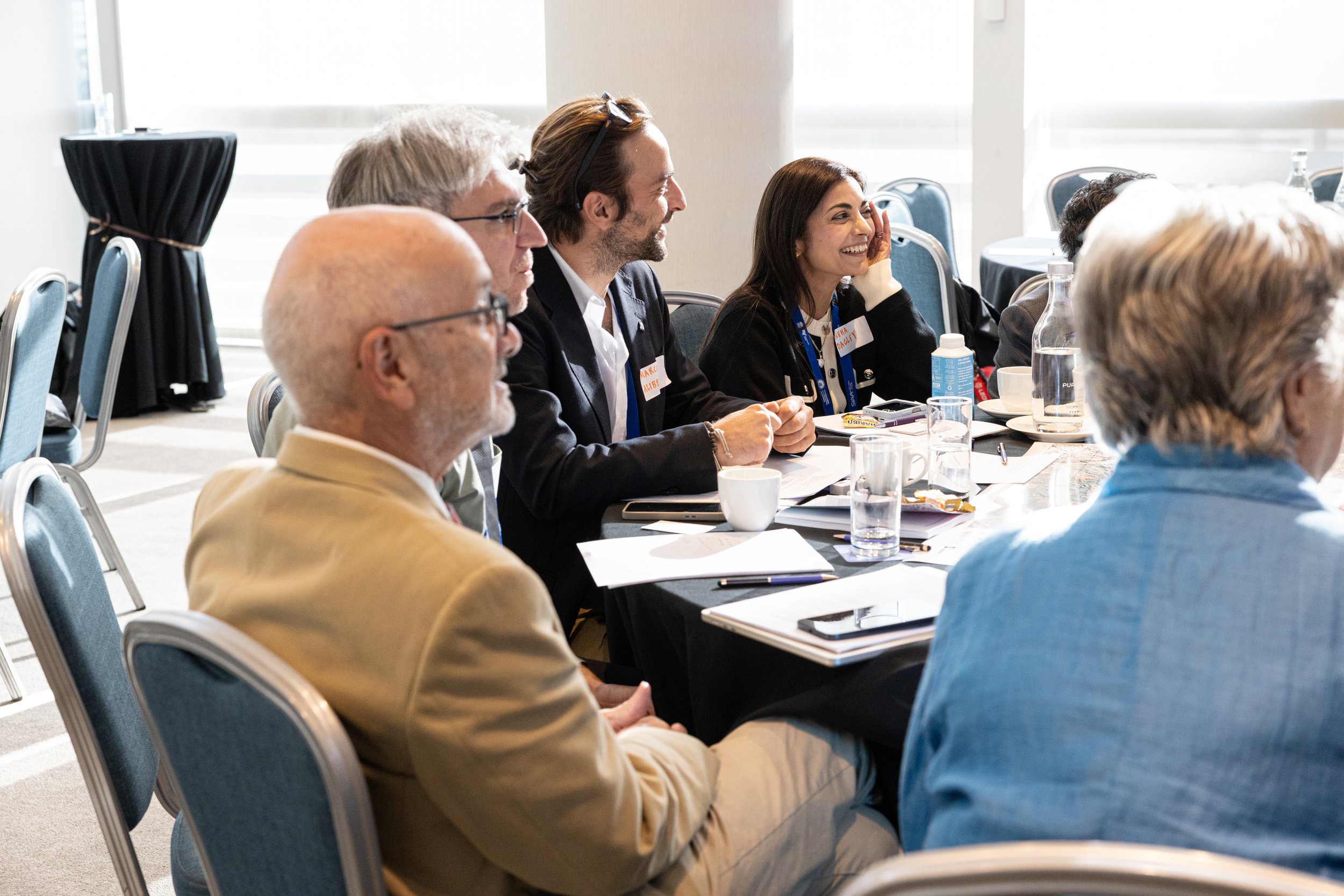
The flagship Open Lunar tabletop, Between the Craters, was playtested by over forty senior experts from government, space agencies, commercial operators, academia, NGOs, media, and international organisations at the 2025 International Astronautical Congress (IAC) in Sydney.
About the Need
Open Lunar’s tabletop simulations are designed to help the global space community anticipate and navigate the governance, policy, and operational challenges emerging as lunar activity accelerates.
As missions, infrastructure, and commercial operations expand on the Moon, decisions are increasingly shaped by incomplete information, divergent norms, differing interpretations of law, and competing political and economic incentives. These dynamics are difficult to explore through traditional policy processes alone.
At the same time, the space sector often is highly siloed, with industry, scientific, government, and legal communities often engaging separately, despite confronting shared challenges. Globally, meaningful dialogue is further complicated by geopolitical tensions, institutional fragmentation, and uneven access to decision-making fora.
Many of the most consequential risks, therefore, arise not from overt conflict or technical failure, but from misinterpretation, misaligned incentives, and the absence of shared expectations across communities and regions. Without structured opportunities to test assumptions and explore these dynamics together, governance gaps are often only recognised once they carry operational, political, or reputational consequences.
About the Solution
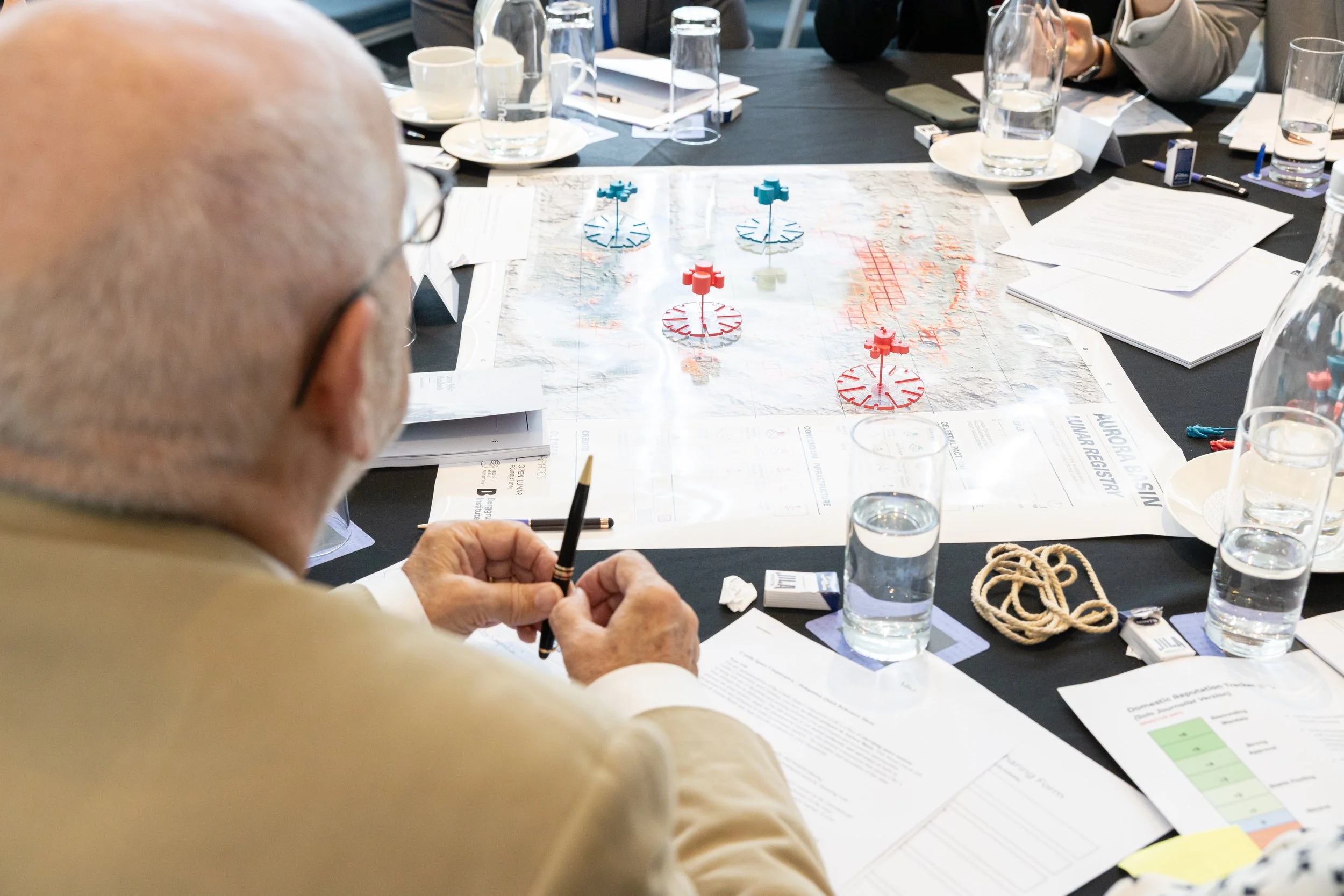
Open Lunar tabletops provide a structured, neutral, and trusted convening environment in which stakeholders can experience how governance, operational, and political pressures interact in practice. By placing participants inside realistic scenarios, the simulations enable a deeper understanding of challenges, risk, responsibility, coordination, leadership, and potential solutions in a rapidly evolving lunar domain.
Unlike traditional workshops or policy discussions, the simulations are designed to surface decision-making dynamics, trade-offs, and unintended consequences as they unfold over time directly from the stakeholders themselves. Simulations are tailored to explore how decision-making unfolds under a range of operational, political, and governance conditions relevant to current, planned, or expected lunar activity.
Open Lunar designs and delivers tabletop simulations in collaboration with partners or as a commissioned service, tailoring each exercise to specific policy questions, organisational needs, and stakeholder contexts. Simulations can be adapted for different audiences and settings, from closed-door strategy sessions to multi-stakeholder convenings alongside international conferences.
Case Study: Between the Craters — IAC 2025
Location: International Astronautical Congress, Sydney
Format: Closed-door, expert tabletop simulation
Partners: Secure World Foundation, Dark Matter Labs, Foresight Institute, Berggruen Institute, Climate Cartographics
Participants: 40+ senior stakeholders from government, national space agencies, commercial operators, academia, NGOs, media, and international organisations across the globe.
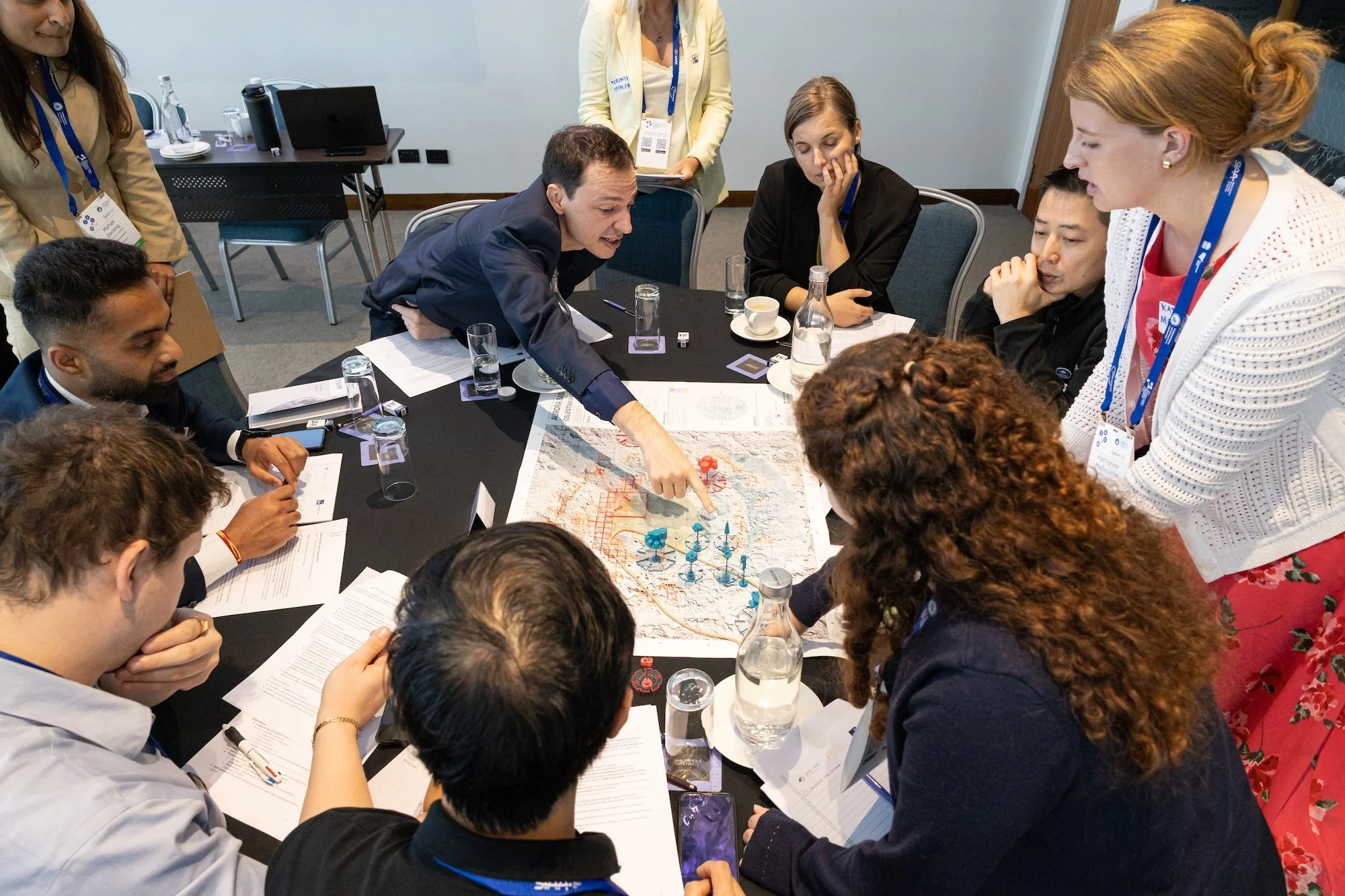
On the sidelines of the 2025 International Astronautical Congress, Open Lunar designed and facilitated Between the Craters, a high-level lunar governance tabletop simulation developed in partnership with the Secure World Foundation, Dark Matter Labs, the Foresight Institute, the Berggruen Institute, and Climate Cartographics.
Set in the fictional Aurora Basin near the lunar South Pole in 2038, the scenario modelled a contested operating environment characterised by permanent infrastructure, commercial extraction, ambiguous operational zones, limited information sharing, and intensifying geopolitical and domestic political pressure. Participants were asked to navigate governance, operational, and reputational challenges in a setting where norms were fragile, interpretations of responsibility diverged, and perception often mattered as much as intent.
The simulation brought together a deliberately diverse group of participants who would rarely engage collectively in traditional policy settings. This cross-sector mix enabled exploration of how technical decisions, political incentives, media narratives, and institutional constraints interact in practice, and how misinterpretation and mistrust can escalate risk even in the absence of overt conflict.
As one government participant noted:
“A highly unique tabletop that brought together in the same room experts and professionals who otherwise wouldn’t interact, and got us thinking about key lunar policy issues and challenges holistically in an engaging, comprehensive, and collaborative way.”
Key insights
The exercise surfaced several dynamics with direct relevance for near-term lunar governance, including:
The central role of information asymmetry and ambiguity in driving mistrust and escalation.
How domestic political pressure and media framing can distort otherwise rational decision-making.
The fragility of informal norms in the absence of shared expectations or coordination mechanisms.
The value of voluntary transparency, communication, and confidence-building measures, even when imperfect.
Participants consistently emphasised that experiencing these dynamics through simulation generated insights that would have been difficult to surface through discussion alone. As one academic participant observed:
“The simulation made clear that the Moon’s future will be decided as much through storytelling and negotiation as through engineering.”
Reflecting on the broader engagement and response, one institutional partner highlighted the level of immersion and cross-sector value created by the exercise:
“The simulation generated unusually high participant engagement. Players described the experience as “forward-looking yet realistic,” and several expressed eagerness to use the resulting case study to explain their own work. One participant noted, “I cannot wait for this to go live so I can send this to people saying, ‘yes, this is what I do.’” Another remarked that she had never participated in an activity so dynamic and intellectually immersive. This enthusiasm indicates that narrative-based simulations can bridge disciplinary andinstitutional silos by giving participants a shared experiential vocabulary.”
Following the exercise, several organisations expressed interest in future runs or adaptations, and participants recommended that the format be further developed for policy, diplomatic, and multilateral contexts. The exercise also produced structured insights and lessons that informed follow-on analysis, discussion, and future scenario design.
Between the Craters demonstrated the value of tabletop simulations as both an analytical tool and a convening mechanism, and now serves as a foundation for Open Lunar’s ongoing tabletop work.
Explore writing and research related to this topic:
The Planetary Compendium — Between the Craters: A Lunar Governance Crisis Simulation
Open Lunar Publication — Between the Craters: A Lunar Governance Crisis Simulation