Terrestrial Policy Frameworks Applied at the Lunar South Pole

AUTHOR: VIC PAULSON
Every proposed lunar governance framework borrows from Earth. UNCLOS, the Antarctic Treaty, UNFSA, ITU spectrum. Each encodes hard-won lessons about managing shared resources without sovereignty. And each of them breaks down when it is applied to the lunar south pole. Lunar water ice is finite, geographically fixed, and non-renewable on any human timescale. No existing framework was built with that in mind.
Every proposed lunar governance framework borrows from Earth. The question is how much the analogy holds, and where it collapses the moment you try to govern a global commons that is finite, fixed, and off-Earth. That's not a criticism of these frameworks but an observation on how international law is currently made. When negotiators wrote the Outer Space Treaty in 1967, they were drawing on Cold War precedent and the newly written Antarctic Treaty (1959). When the Artemis Accords introduced "safety zones" in 2020, they based this logic on maritime exclusion zone logic. We are already seeing the use of adapted Earth policies as proposed ways to govern the Moon, but how far do these hold before looking to Earth policy becomes limiting?
Why Earth policy analogs at all?
The Outer Space Treaty, while offering some useful principles, creates a policy vacuum. It tells us the Moon belongs to all of humanity and that no nation may appropriate it by claim. However, its principles were written for an era of national programs and broad declarations, not for the operational specificity that increased commercial activity demands. As the number of actors and planned missions grow, the gaps become concrete. For example, no current framework exists to resolve two operators wanting access to the same crater. This may be why we see so many Earth prescriptions in lunar policy, strategists reaching for the closest frameworks they know. Lunar mission planners have no choice but to plan under these frameworks, even while recognizing that the unique conditions of the Moon may ultimately require new approaches. Reaching for earthly policies is a reasonable instinct. These frameworks encode what nations have agreed to, where enforcement holds without central authority, and where commons management breaks down. Yet each analog was developed for a resource that behaves differently than lunar water ice: fish migrate, spectrum persists, and Antarctic resources stay unextracted. The Moon challenges many of the assumptions underlying these governance models and raises questions about how well they can be adapted to the lunar environment.
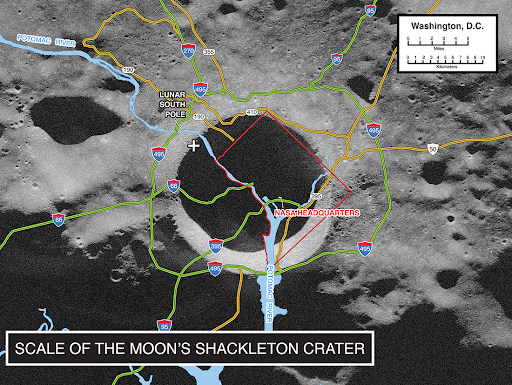
The next step, though, is extending these existing norms into new domains, testing them under new conditions, and adapting them where they prove insufficent. The challenge is that the nature of operations and resources at the lunar south pole pushes beyond the assumptions embedded in many current governance frameworks. Water ice in permanently shadowed regions is finite, geographically fixed, and non-renewable, and no existing policy framework was built with those properties in mind. Fish stocks are a common example of the “Tragedy of the Commons," but water ice doesn't migrate the way fish do. Spectrum management in space policy has seen the most coordinated international progress, but water ice doesn't persist through use the way spectrum does. It doesn't replenish between seasons. The number of lunar operators will outnumber the roughly dozen sites that combine ice concentration with operational accessibility in the upcoming decade. Who will get access to the more favorable sites?
Earth policy analogs: Four frameworks, four failure points
UNCLOS: Law of the Sea
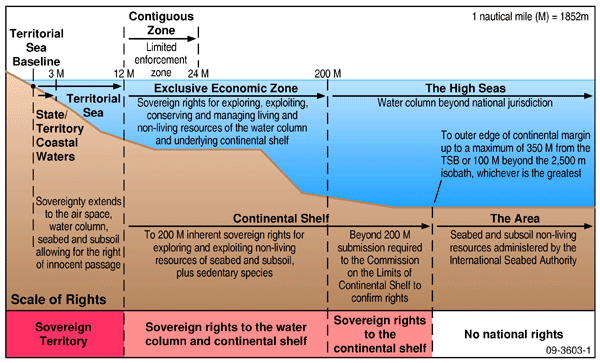
UNCLOS is one of the most sophisticated, if not the most sophisticated, international resource governance frameworks ever written. It manages shared access to the oceans, where no single nation holds sovereignty; creates rights through Exclusive Economic Zones (EEZs); and establishes the common heritage of mankind principle for deep seabed resources.
There's also a political precedent worth noting. The US never ratified UNCLOS, objecting specifically to Part XI's common heritage provisions: mandatory technology transfer, revenue sharing, and the constraints placed on commercial resource access. That same objection is already audible in the Artemis Accords: safety zones negotiated bilaterally between signatory nations rather than a multilateral resource regime open to all, operational norms rather than binding equity obligations. The Accords are, in part, a deliberate choice to route around exactly the kind of commons framework UNCLOS tried to build.
Gets Right: shared resource access without full sovereignty. States hold enforceable rights over resources without claiming the territory those resources sit in. This mirrors the logic that any OST-compliant lunar resource framework would need to follow: resource rights without territorial claims.
Breaks Down: fish renew; ice does not. UNCLOS was built for renewable stocks and effectively inexhaustible deep-sea mineral deposits. Neither condition holds for PSR ice. There's no sustainable mining on the lunar surface when sustainability is defined as a resource replenishing itself. The spatial logic of EEZs also fails under lunar conditions since rights in EEZs are proportional to coastal adjacency. There is no lunar equivalent of a coastline, and and unlike EEZs, which derive their enforceability from coastal sovereignty, no single actor holds sovereignty on the Moon. Defining lunar assets as a coastline analog would allow nations to manufacture that anchor artificially, claiming zones the legal framework was never meant to support.
Lunar adaptation needed: finite, non-renewable resource rules and an access framework that doesn't depend on adjacency-based claims.
Antarctic Treaty System
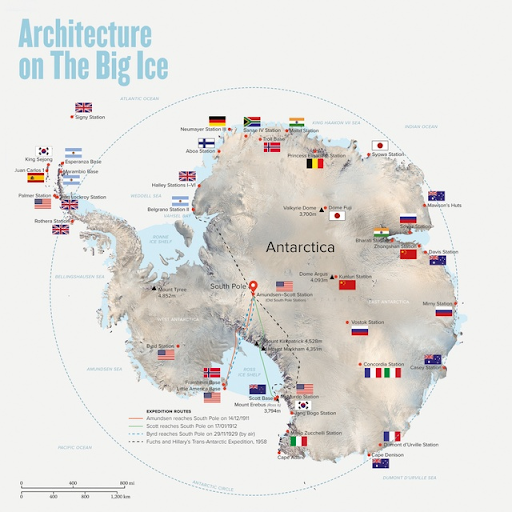
The Antarctic Treaty of 1959 is the clearest proof that nations can share a remote area under a non-appropriation principle. During a period of political and military escalation around the continent, twelve original signatories, including the US and the USSR at the height of the Cold War, agreed Antarctica would be reserved for peaceful purposes—as a result, territorial claims were frozen, and scientific research was shared freely. The treaty has been held for over 60 years with 56 parties.
Gets right: managing and redirecting geopolitical competition into scientific cooperation. The data-sharing and cooperative presence norms are ones that should be taken to the Moon.
Breaks down: Antarctica has mineral deposits, but the 1991 Protocol on Environmental Protection banned extraction before commercial pressure could build because the parties understood that extraction would fracture their cooperative framework. However, many lunar actors have designed missions and strategies around the ability to extract lunar resources.
Lunar adaptation needed: an extraction rights framework needs to be layered on top of the cooperative presence norms.
UNFSA: UN Fish Stocks Agreement
UNFSA doesn't get cited as much in lunar governance literature as the earlier models, but this 1995 agreement addresses multiple sovereign actors competing for a shared, depletable resource in a commons governed by the common heritage principle, with explicit equity for developing states.
Gets right: equity in the form of access provisions for less technically capable states, conservation through mandatory stock assessment and precautionary limits under uncertainty, and data-sharing as a condition of participation.
Breaks down: stock mobility enables sharing. The fish stocks UNFSA governs migrate across EEZ boundaries, which is precisely what makes a cooperative framework rational. However, PSRs are fixed. Assignment of extraction rights to a specific crater is zero-sum in a way that a fishing quota is not.
Lunar adaptation needed: replace stock assessment with PSR ice mapping as the shared scientific data foundation. Keep the equity architecture and the precautionary framework. The mobility assumption doesn't transfer.
ITU Spectrum Allocation
The ITU manages geostationary orbital positions and radio frequency allocations under a first-come, first-served registration system. It's one of the few examples of managing a finite, non-interchangeable, geographically constrained resource in a commons without a territorial claim framework. The coordination requirement—that operators may use a slot provided they coordinate with adjacent users and protect against interference—manages to create order without sovereignty.
Gets right: managing finite, congested resources via registration in the space environment. The interference coordination logic also maps directly onto lunar surface operations, where a mission's exhaust plume can contaminate an adjacent operation's instruments or solar panels.
Breaks down: spectrum is non-depletable. A frequency used by one operator isn't consumed. An orbital slot vacated by a decommissioned satellite becomes available to the next registrant. Applying ITU-style first-come priority to PSR extraction rights would reward speed over equity with no response for PSR depletion.
Lunar adaptation needed: add resource depletion accounting that tracks extraction against total stock estimates and triggers review as reserves decline, and address first mover advantage, where early operators claiming the most accessible sites lock out later arrivals before any coordination framework is in place.
Earth Policy Analogs Overview
| UNCLOS | Antarctic Treaty | UNFSA | ITU Spectrum | |
|---|---|---|---|---|
| Core principle | Free high seas + EEZ sovereignty rights | No territorial claims, scientific freedom | Cooperative management of shared fish stocks | First-come, first-served for orbital/spectrum slots |
| Gets right | Shared access without sovereignty | Managing and redirecting strategic competition | Equity, conservation, data-sharing among asymmetric actors | Managing finite, congested resources via registration |
| Breaks down | Fish renew; ice does not. No lunar equivalent of coastal adjacency | No extractable resources at scale and no commercial actors | Stock mobility enables sharing; PSRs are fixed, assignment is zero-sum | Spectrum is non-depletable; extraction depletes permanently |
| Lunar adaptation | Account for finite, non-renewable resource rules | Add extraction rights framework | Replace stock assessment with PSR ice mapping as shared the data foundation | Add depletion accounting; priority rules must yield to equity goals |
The common failure point
Lunar water ice is finite, fixed in location, and non-renewable on any human timescale. Fish stocks survive the governance pressure because they renew. Orbital spectrum survives because it isn't consumed. Antarctica avoids it by banning extraction. ITU avoids it because depletion isn't part of the spectrum problem. None of these frameworks were built for a resource that is genuinely, irreversibly exhaustible at realistic extraction rates.
Any framework serious about the lunar south pole has to start with non-renewability as a design constraint, not a special case. How do you allocate access to something that can't be replaced? How do you build equity provisions when late arrivals can't wait for restocking? How do you set limits when there's no sustainable yield to calculate?
Scale of lunar PSRs
The adaptation
No single framework adapts cleanly. But each one donates something that a lunar policy hybrid can be built from.
From UNCLOS: the common heritage principle and the licensing authority architecture that allocates access rights within a sovereignty-free framework.
From the Antarctic Treaty: the non-appropriation norm under operational stress and the data-sharing infrastructure that treats scientific observation as a shared foundation rather than a competitive asset.
From UNFSA: the provisions for less technically capable actors built in from inception.
From ITU: the registration-based coordination mechanism and the interference management logic as a model for surface operations proximity rules.
What a lunar framework has to add from scratch is a depletion accounting mechanism that tracks extraction against stock estimates and triggers renegotiation as reserves decline.
What comes next?
The next post asks whether looking to the terrain can answer these open questions. Slope, illumination, temperature, ice concentration, and proximity to landing sites vary dramatically across the South Pole, and they vary in ways that map directly onto what different mission types actually need. The geology doesn't resolve the governance problem, but it may define the geometry of any viable solution.
Lauren Victoria Paulson (Vic) is a 2026 Open Lunar Fellow. Her fellowship work centers on a digital simulation sandbox for testing DLA governance regimes at the lunar south pole, where players act as lunar operators making real asset deployment and resource extraction decisions under different governance configurations. The goal is to make the consequences of governance choices visible and testable before they get codified.